

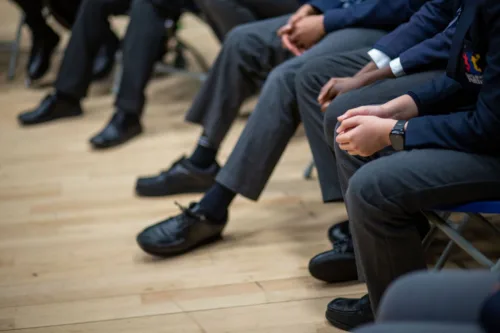
‘Giving boys the permission to play, to laugh and to be emotional, without fear of being seen as less of a “man” feels the most important thing we can do, if we’re going to balance things out.’
I’ve just finished the new series of Time which is about the prison system in England. This series is set in a young offenders institution, which is where I began my career – teaching drama to young men. You can imagine how well that went! A memorable low point was improvising an airplane highjack where I played one of the hijackers (the boys had suggested this idea). At one point I shouted, ‘all on the ground now!’ Suddenly, there was the sound of prison officers’ boots hurtling down the education corridor. The door burst open to a scene of 15 young offenders lying face down on the ground and a (stupid and embarrassed) 23-year-old standing amongst them holding an imaginary machine gun. Bizarrely, I kept my job.
I learned so much from working with those young men. They were brutally honest, telling me exactly what they thought of me – physically and as a human being. But the sense that many of them had been brutalised was so clear, even to an ignorant and naïve drama facilitator.
At the same time as watching Time (David Tennant, a supporter of Tender, is excellent), I’m reading a novel set in 1982 about a 13-year-old boy. He is constantly navigating the ‘rules’ of being a teenage boy – the hierarchy of popularity based on physical strength, the ability to smoke in a cool way and excellence in sport (football). The rules must be exhausting to follow – like living in a country where the language spoken is not your first.
I was 13 in 1982 and I have a distinct memory of being relieved not to be a boy. I remember thinking that if I was, I’d have to have a lot of fights and that felt frightening and awful. It didn’t occur to me that boys might feel this way too, but were under pressure to behave in ways that weren’t necessarily natural to them.
The young men in Time are brutalised. They’ve committed serious and violent crimes, and many are so physically large, it is hard to remember they are children. There is no avenue for them to be anything other than brutal and violent. Characters attempt to rectify this but there is little sense of optimism that much will change for them.
I worked first with young offenders and then with adult male inmates. There appeared to be an almost magical age of 30. This was when the men seemed to settle, to be slightly more at peace with themselves. It felt sad that it took three decades to reach a point where they were a little more comfortable in their skin. That sense of ease shifted the way they interacted with other people. They were more polite to me (kept their opinions about me to themselves a little more!), they talked more openly to one another and they were more confident to join in the drama sessions. They could play, they could laugh and they could create.
My work over the past two and half decades to try to prevent violence against women and girls has often led some folk to believe I hate men or that I blame all men for the violence. That couldn’t be further from the truth. I hold in utter contempt the people who hurt others, who frighten and bully others. But I’m aware of the pressures on men – and especially on boys and young men. Women and girls have pressures too but this is not a competition for who has it worst. While we try to turn it into a competition (men’s mental health vs. women’s experiences of violence), we’ll never solve the problem. As my fabulous colleagues at Respect say, ‘patriarchy is bad for everyone’.
Watching Time was depressing but important. Giving boys the permission to play, to laugh and to be emotional, without fear of being seen as less of a ‘man’ feels the most important thing we can do if we’re going to balance things out. If we make it easier for us all to inhabit a world where we aren’t constantly navigating the rules of a system we didn’t create, then we can all feel safer, more at ease with ourselves and more at ease with others.
Further information
Tender CEO Susie McDonald MBE is available for interview.
For interview requests and further media enquiries, please contact katevine@tender.org.uk / isadora@tender.org.uk.
Visit Tender’s Media centre.


